Could you learn all that you need to know about reading, science, and math in just two hours? Two hours spent staring at a screen, with the help of an AI teacher, that is?
A small group of students across the country are testing it out. They’re the next generation of learners molded and shaped by the tech teaching of Alpha School, the “AI-powered private school” touted by the federal government as a possible future for education.
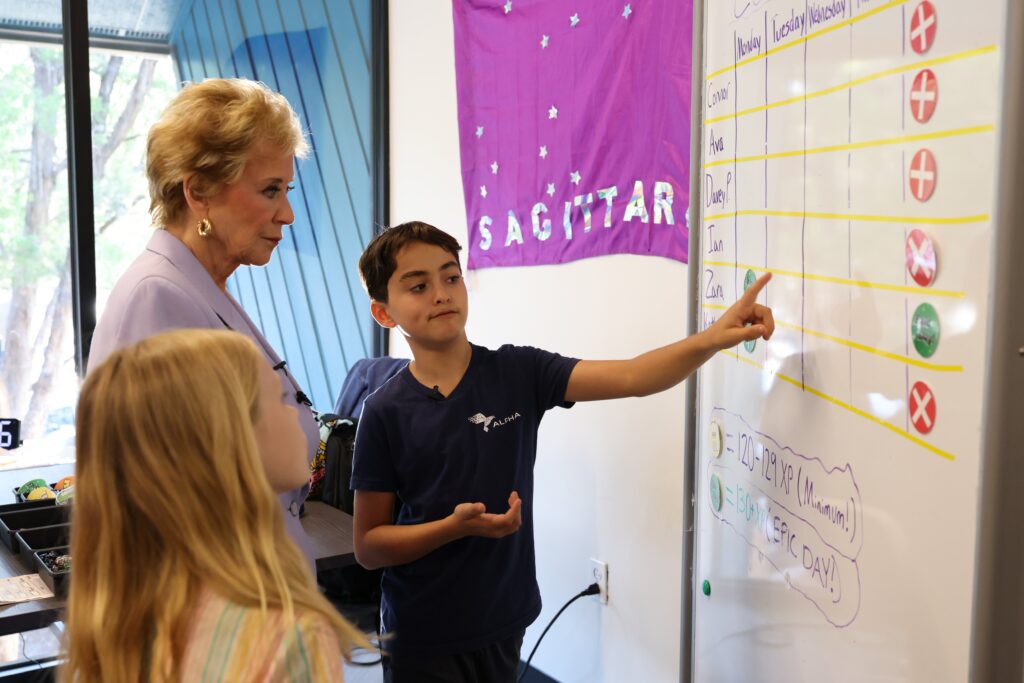
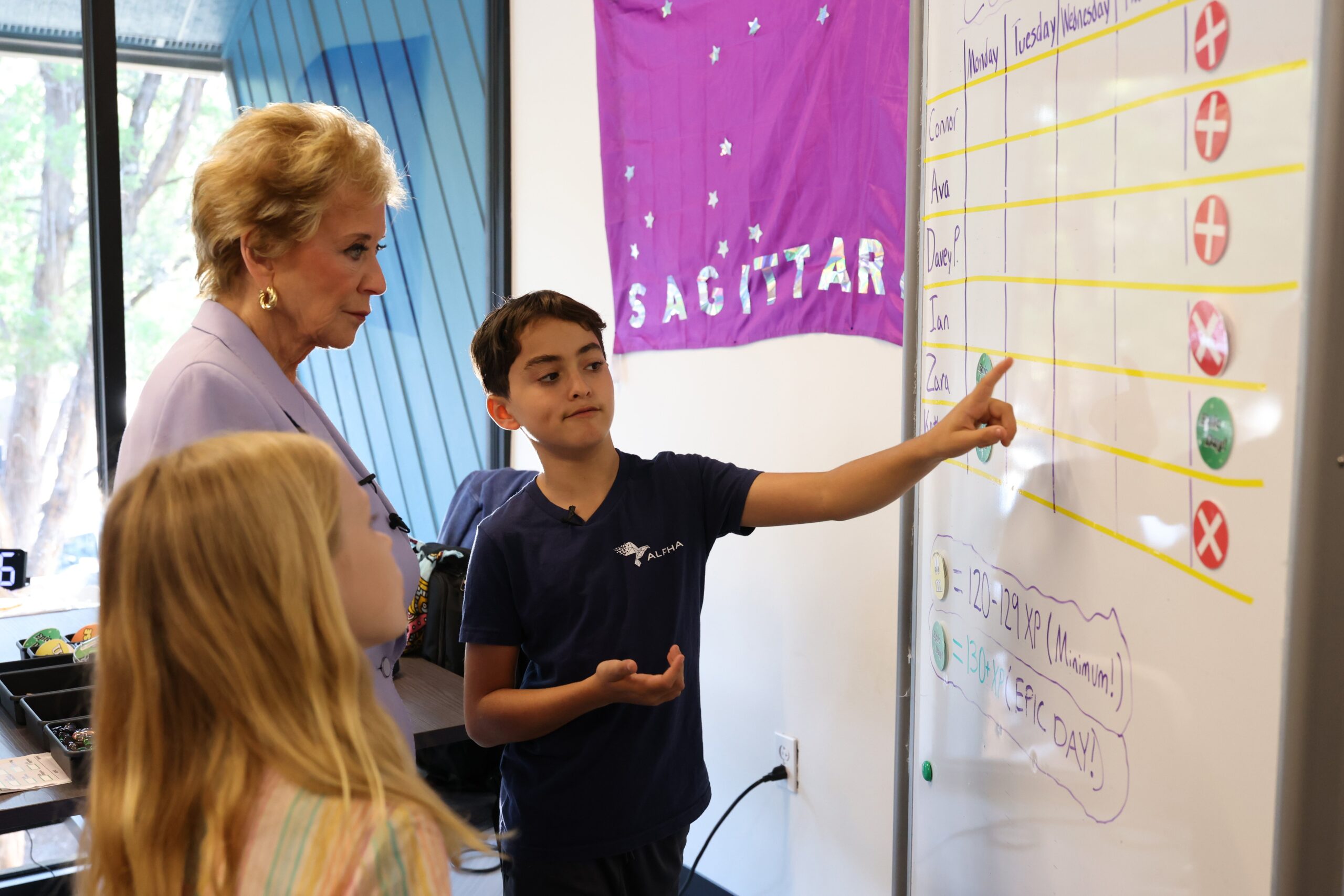
In a September visit to an Alpha School campus in Austin, Texas, Department of Education Secretary Linda McMahon said that the school was full of potential, an “exemplary” case of what tech can do for American education. The school’s co-founders claim there is strong interest in their learning system, which has gained favor among advocates of expanded school choice and alternative learning.
But what exactly is Alpha School selling — and should we take its model seriously?
What is Alpha School?
Alpha School was founded in 2014 by educational podcaster and 2 Hour Learning founder MacKenzie Price and software and private equity billionaire Joe Liemandt. It’s not new to the scene, and it exists within a plethora of tech-focused alternative school programs sold to families discouraged by public school curriculum.
AI developers, including OpenAI, Google, and Anthropic, have pushed their way into academia, releasing products designed for classroom instruction, educator support, and general student learning. Meanwhile, educational companies have designed their own products to build on their standard course materials, like specialized chatbots for specific math courses or leveled reading skills.
Alpha School suggests something more extreme. Instead of a helpful supplement to human learning, AI is the students’ sole instructor, grader, and academic administrator.
The K-12 curriculum was designed with assistance from “world-renowned learning scientists, advanced degreed academic experts and researchers,” Alpha School says.
Like other alternative schools, students divide their time between a practical and academic curriculum: Students spend just two hours each day on core subjects, reading and math, “using A.I.-driven software,” the New York Times reports. AI-supported practical skill-building — like entrepreneurship, public speaking, and financial literacy — takes up the rest. All of it is tracked on an AI platform that creates highly individualized lesson plans for each student, rather than classes as a whole. Schools do not employ teachers, but rather human “guides” who do not manage grades or curriculum but can offer specialized teaching, like handwriting. Guides don’t need postgraduate or educational degrees to work for Alpha.
“What if your child could crush academics in just 2 hours and spend the rest of their day unlocking limitless potential?” the private school writes on its website. “Your kids can accomplish twice as much if they’re not sitting in a one-size-fits-all classroom for 6 hours.”
In a New York Times article from last year, the school reported serving 200 K-8th-grade students and another 50 high school-level students, it expected to expand to dozens of locations by the end of 2025. Tuition ranges from $10,000 to $75,000 a year, reported CNN.
Is there an Alpha School near me?
Alpha School operates in-person classes – some of which are conducted in leased spaces at existing private schools — in several states around the country, including Los Angeles, New York City, Chicago, and Brownsville, Texas, the SpaceX company town tied to CEO Elon Musk. Many of these locations overlap with major tech hubs, like campuses in Palo Alto and San Francisco.
Alpha also offers an at-home learning program, Alpha Anywhere, that provides personalized courses, academic support, and professional coaching.
Does AI-based learning actually work?
Parents who placed their kids in Alpha School years ago say their children had mixed experiences. Many eventually pulled their children from the program, reported CNN in a recent Alpha School investigation. Parents told the publication that they had reservations about relying on apps for learning, with little to no human intervention. They found that the AI instructors had set hard-to-meet goals, forcing students to overwork themselves without the support and flexibility of a human instructor.
Alpha School’s lack of human involvement is particularly worrisome, according to some learning experts.
“While I do think personalized AI tutors can work well if designed in a way that supports productive struggle, decoupling the human connection from instruction entirely seems very concerning. How can humans play the role of ‘motivators’ if they are not even involved in instruction?” said Hamsa Bastani, associate professor at the University of Pennsylvania’s Wharton School and AI researcher.
“When you have a school that is strictly A.I., it is violating that core precept of the human endeavor and of education,” Randi Weingarten, the president of the American Federation of Teachers, told the Times last year.
Bastani and her colleagues are open to AI’s learning potential, but the science hasn’t quite gotten there yet. Bastani was co-author of a 2024 study that found that highly motivated students could benefit from AI-assisted studying — but the tech had little effect on actual test scores. Additional research has shown that AI can have modest positive gains for student learning, in specific scenarios, while other studies have found AI chatbots to hinder learning perception and impede types of thinking. To summarize: There is no scientific consensus on the impact of universally designed chatbots, such as ChatGPT, on learning.
Just as alarming, experts say, is Alpha School’s lack of open evaluation, which, Bastani explains, is necessary to iterate and improve AI systems. A lack of internal or independent human evaluation “sets the stage for bad AI design broadly,” Bastani says.
Still, the desire for new modes of learning, amid an overburdened and underfunded education system, is strong. The U.S. government and its Big Tech allies, both with their own AI agendas, see the new tech as a solution. But we are still reckoning with the effect of screen time and a new wave of Generative AI tools on young learners. And, as experts say, the science just isn’t there yet.