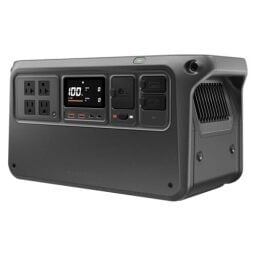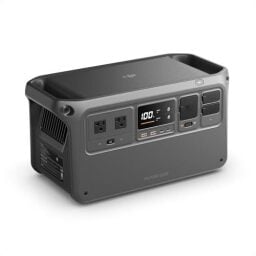
What started as the drone company is now so much more. In addition to DJI drones, it appears as if every content creator is using the DJI Mic Mini (and rightfully so), and the brand’s lineup of handheld cameras, like the DJI Osmo Pocket 3, sure earn their spot as some of the best options on the market. But in recent years, DJI has added another major category to the product lineup that’s also essential for creators — portable power.
The world of portable power stations is expanding the day, proving themselves awesome during power outages, camping, job sites, and content creation adventures. The market is dominated by big-name players like Bluetti, Jackery, Anker, and EcoFlow.
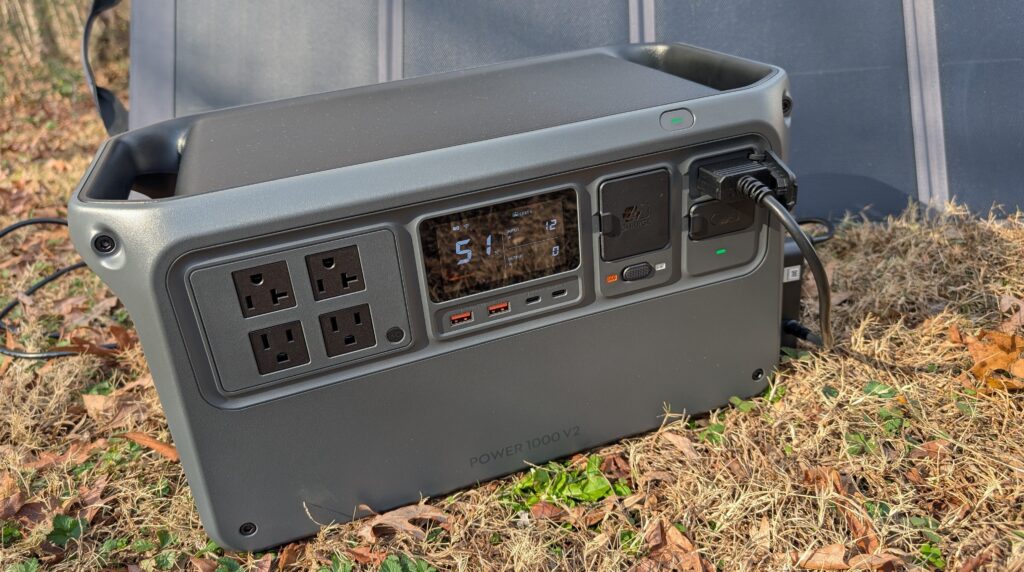
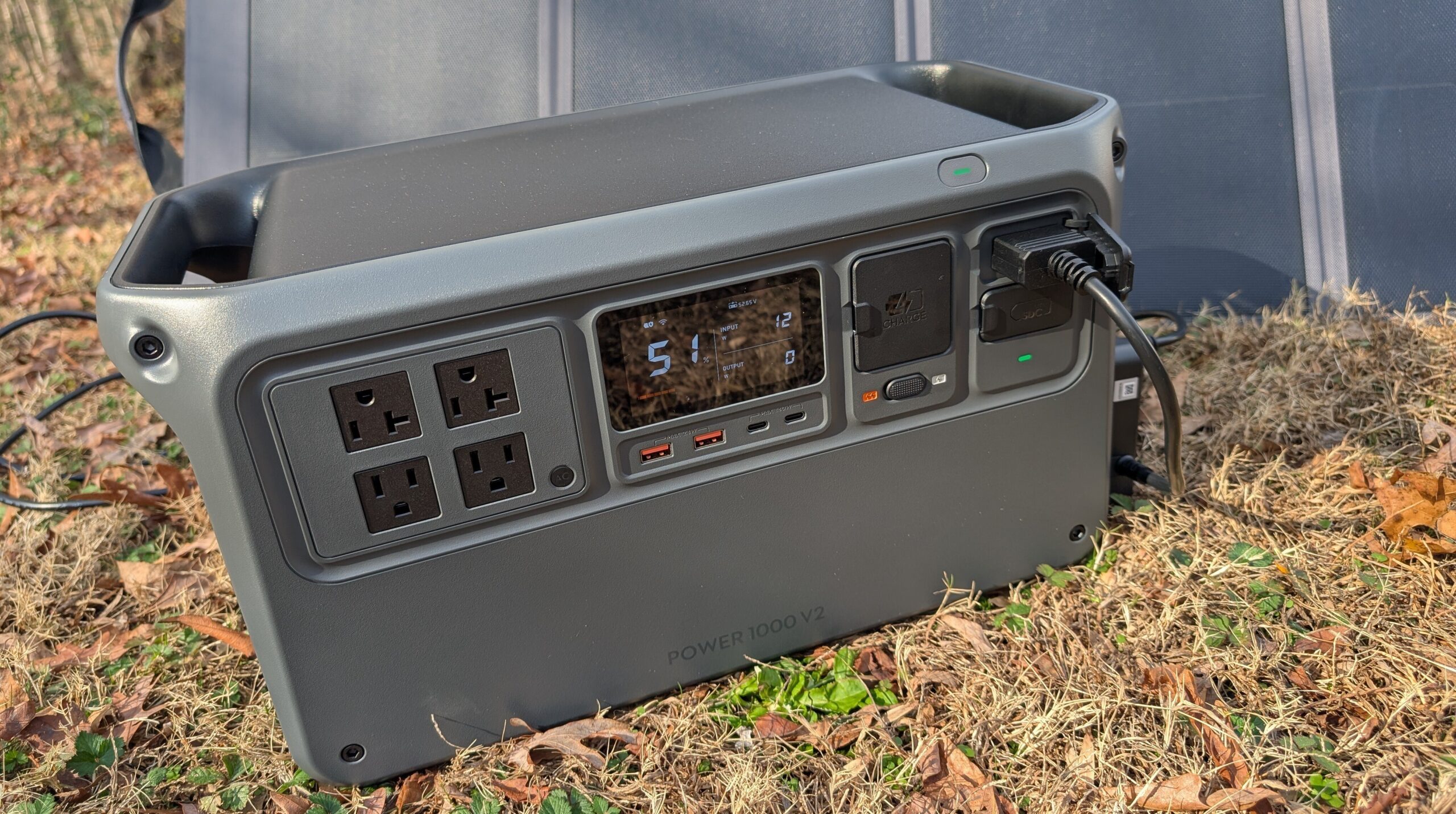
But DJI is quietly in the background, pumping out some of the best options that cater specifically to content creators. The brand has the beefy DJI Power 2000 and the mini DJI Power 500. But the DJI Power 1000 falls nicely in the middle of these two, offering 1,024Wh of power, and the brand just revamped the portable power station to give us the DJI Power 1000 V2. It’s an upgraded model compared to the first generation and comes with some solid improvements.
Credit: Lauren Allain / Mashable
After testing the upgraded DJI Power 1000 V2, I’m convinced this is a great model for content creators, those who prioritize a super-quiet power station, or anyone looking for exceptional value in portable power.
What I love about the DJI Power 1000 V2
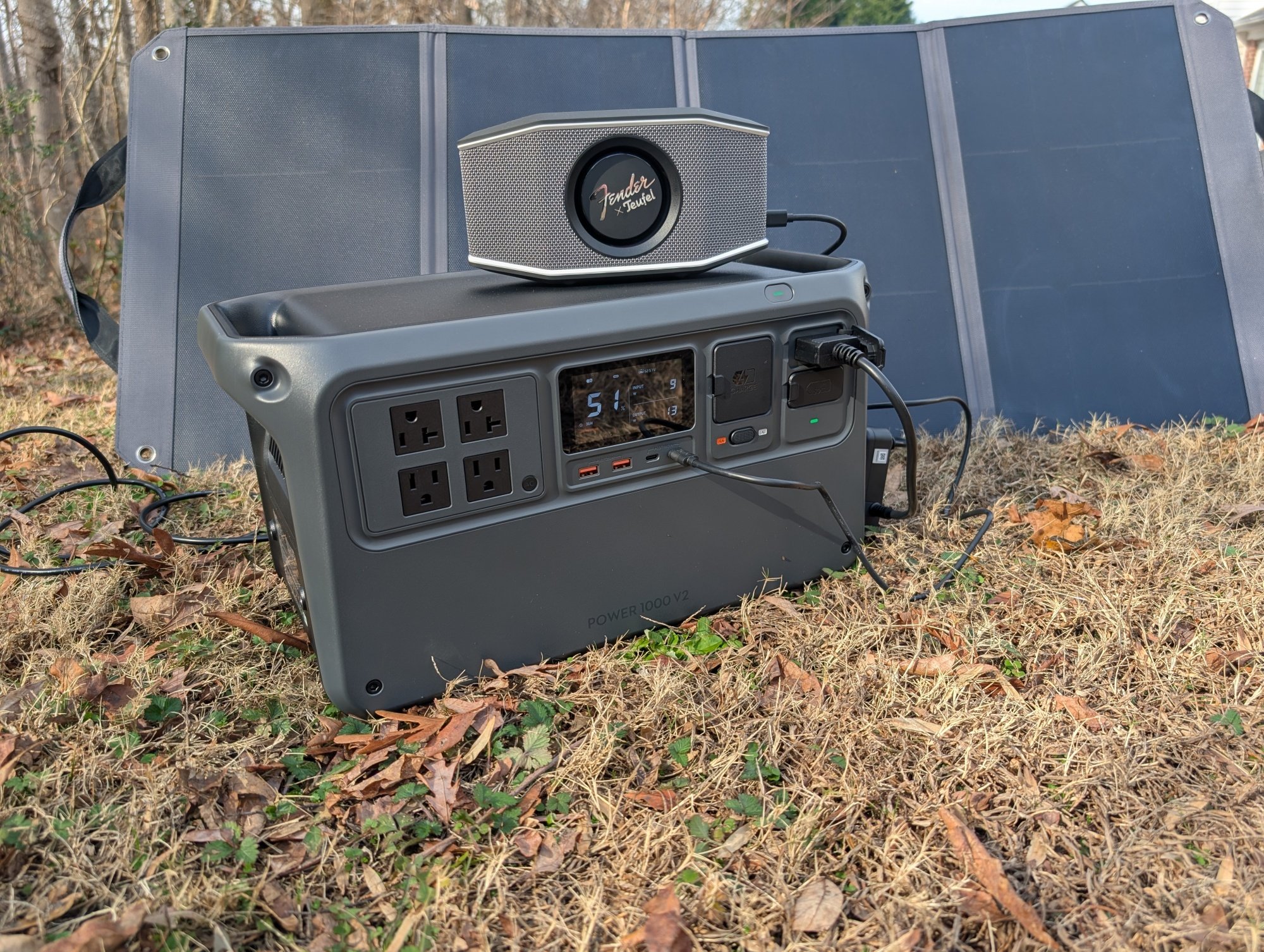
Straight out of the box, the DJI Power 1000 V2 has a sleek and refined design. It’s also fairly compact for a power station in the 1,000Wh category. It weighs about 31 pounds and has ergonomic handles on both sides. While I wouldn’t want to haul this around all day, I felt comfortable unboxing it, carrying it around the house, taking it into the yard, and it was no issue to lift it into my car. The weight of a portable power station is incredibly relevant since you might be carrying it up a set of stairs during a power outage, moving it around the campsite, or pulling it around during a content creation session.
Another major benefit that I love is the near-silent operation of the DJI Power 1000 V2, which DJI says is as quiet as 26 decibels. That’s going to be important for content creators who are filming near the power station and don’t want a loud fan sound in the background. In non-creator scenarios, going with an ultra-quiet portable power station means it’ll be easier to have on while sleeping should you be charging your phone overnight, operating a CPAP, or using it in the kids’ bedroom during a power outage.
It also shines when it comes time to recharge. It takes just 56 minutes to go from dead to 100 percent battery power when recharging with standard wall power. A 37-minute recharge will get the power station back to 80 percent capacity.
Here’s a full rundown of highlight specs on the DJI Power 1000 V2:
Specs
-
Capacity: 1,024Wh
-
Continuous output: 2600W
-
Weight: approx. 31 pounds
-
Dimensions: 17.6 in. L × 8.9 in. W × 9 in. H
-
Power options: 4 AC, 2 USB-C (140W), 2 USB-A, 1 SDC, 1 SDC Lite
-
Recharging options: Grid power, solar, car
-
Battery type: LiFePO4 (lithium iron phosphate)
-
Life cycles: 80 percent capacity after 4,000 cycles
-
Operating and storage temperature: 14 degrees to 113 degrees Fahrenheit
-
Recharging temperature: 32 degrees to 113 degrees Fahrenheit
How does the DJI Power 1000 V2 compare to the original DJI Power 1000?
Since this is the second generation of the DJI Power 1000, it’s worth comparing the new V2 to the original. DJI added some small but significant upgrades to the new V2 model that make it a lot more appealing compared to the original. After testing and comparing the specs, I can’t see a reason why anyone would prefer the original Power 1000 to the new V2, unless the original was way cheaper. Here are the improvements DJI made with this second version and why I’d go with the Power 1000 V2.
More ports
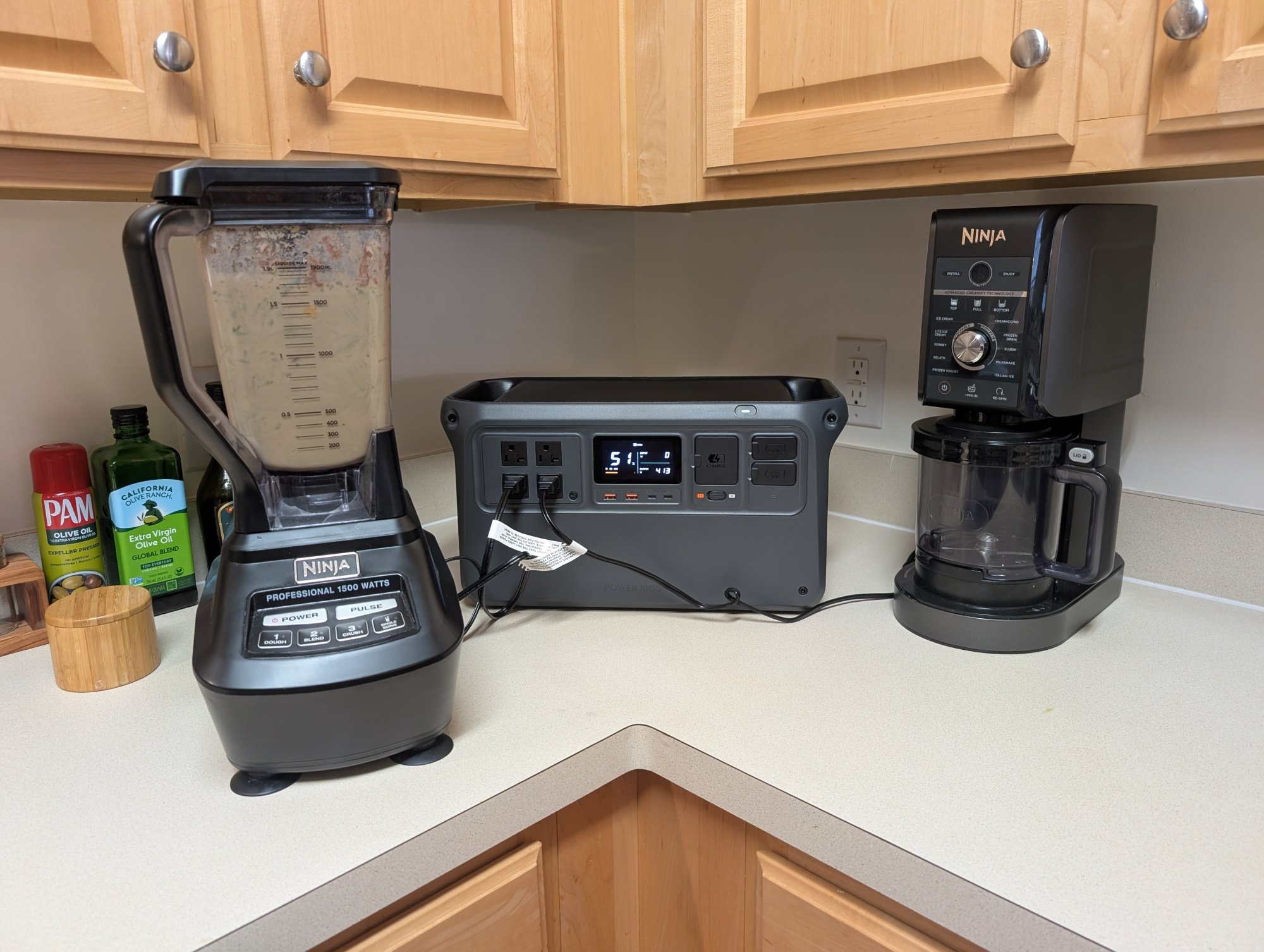
One of the most obvious upgrades from the original to the Power 1000 V2 is the addition of two AC ports for a total of four. That’s much more in line with the industry standard for a 1,000Wh portable power station. Two feels very skimpy while four feels acceptable. But it’s worth noting that other brands offer more ports. For example, one of my favorite portable power stations, the Anker Solix C1000 Gen 2, has five AC ports.
The dual USB-C and dual USB-A ports on the DJI Power 1000 V2 are identical to those found on the original Power 1000, as are the two SDC ports.
Credit: Lauren Allain / Mashable
Higher altitude
Specific to content creators, overlanders, or adventurous campers, the DJI Power 1000 V2 works at higher altitudes. The original topped out at 3,000 meters, but the new V2 can still operate at heights of up to 5,000 meters. That elevation is damn impressive when we consider the Matterhorn tops out at 4,478 meters.
Better stable output
DJI amped up the continuous output with the Power 1000 V2. The original topped out at 2,200W, but the new V2 packs in 2,600W. DJI’s example of this in real life includes powering up a 2,300W electric heater while also powering a 200W projector and giving 27W to recharge a phone. In total, the DJI Power 1000 V2 has an 18 percent higher continuous output.
Quicker recharging
Another major, but less obvious, upgrade is much quicker recharging on the Power 10000 V2. The older original Power 1000 took about 70 minutes to fully recharge with standard wall power. The new Power 1000 V2 takes just 56 minutes to fully recharge. That’s 20 percent faster, shaving nearly 15 minutes off recharging time. For those in the middle of a content creation session, that could be a major difference.
Major expansion possibility and great accessories
The thoughtfulness of the design on the DJI Power 1000 V2 shines through for both expansion ability and accessories. The Power 1000 V2 can connect to up to five DJI Expansion Battery 2000, each adding 2,048Wh. Take the initial 1,024Wh on the Power 1000 V2 and add five Expansion Battery 2000 to the mix, and you’re in line for a total of 11,264 Wh. Each DJI Expansion Battery 2000 sells for $899.
What I love about portable power stations that have the ability to link up with extra batteries is that you don’t have to commit to a specific power need. Grab the DJI Power 1000 V2 and then see how it goes. Maybe the 1,024Wh is sufficient for you. But if it’s not, it’s super easy to grab an extra battery. This approach can also be beneficial if you’re looking to get portable power but don’t want to dish out the big money for a larger power station right now.
You’re probably wondering how you’d possibly haul around a portable power station with five batteries stacked above it, and that’s where the thoughtful DJI accessories come into play. The DJI Power Expansion Battery 2000 Hand Truck Combo offers a stable way to cart around major amounts of portable power.
Credit: Lauren Allain / Mashable
Credit: Lauren Allain
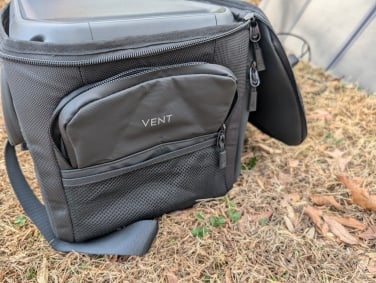
I feel silly saying this, but I adore the DJI Power 1000 Protective Storage Bag. It makes carrying the power station a breeze, and its design allows for full access to all ports without taking it out of the bag. There’s also a zippered area for storing cables.
The benefits of the DJI Power 1000 V2 for DJI drone owners
The two SDC ports on the DJI Power 1000 V2 are unique to DJI portable power stations, and you won’t find them included on power stations from other brands. This is relevant to those with DJI drones because it gives access to super quick recharging of drone batteries.
The award for the fastest DJI drone battery recharge goes to the Inspire 3 TB51 Intelligent Flight Battery, which charges from 10 percent to 95 percent in 28 minutes with the DJI Power 1000 V2. The Air Series 3 Intelligent Flight Battery goes to 95 percent in 30 minutes. The slight hitch here is that you’ll need to purchase the fast-charge cable to get this drone-recharging benefit. However, the good news is that the cable costs about $20.
What I don’t love about the DJI Power 1000 V2
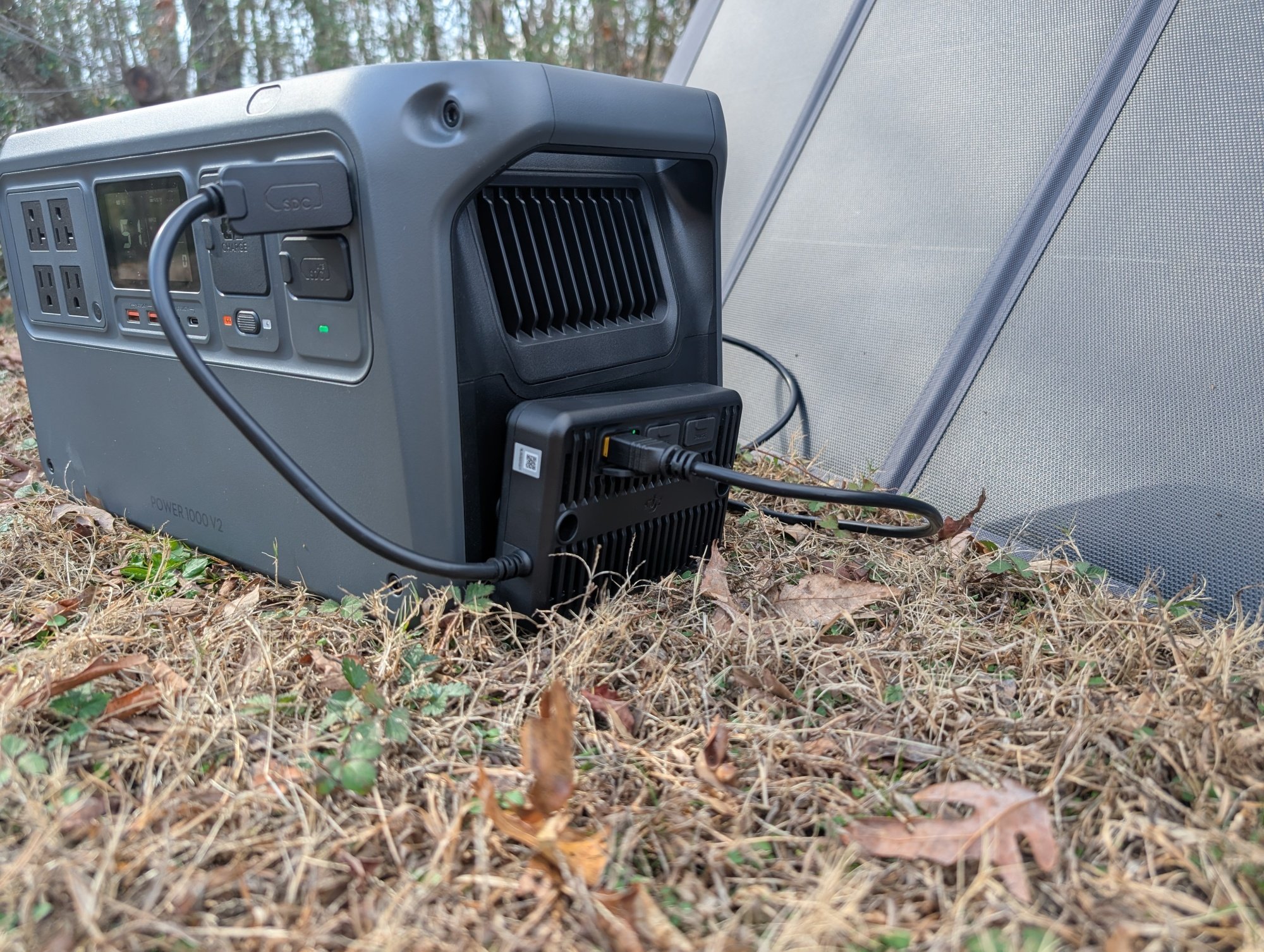
While the SDC ports are great for fast-charging DJI drones, they prove troublesome in other aspects. My main gripe is that, true to other DJI portable power stations, the Power 1000 V2 does not have built-in ports that connect to solar panels. If you want to recharge with solar, you’ll have to purchase the DJI Power Solar Panel Adapter Module, which sells for $59. This is a bit of a letdown considering that every other portable power station I’ve tested has built-in ports that connect to solar panels. If you don’t plan on recharging with solar panels, you can ignore this con.
Credit: Lauren Allain / Mashable
My other disappointment with the DJI Power 1000 V2 is that it doesn’t have an onboard external light. The display is perfect for getting all the stats you need about the station, but I love a power station that has a built-in flashlight. It’s so much nicer to climb stairs while carrying a power station with a light on the station itself. It’s also awesome to use during power outages. This lack of light is not unique to this particular portable power station. Most brands seem to be moving away from including a built-in light, and while I’m sad about it, it’s not like we don’t have other light sources.
Is the DJI Power 1000 V2 worth buying?
At full price, DJI is selling the Power 1000 V2 for $699. That falls into a fairly standard price range for a portable power station in the 1,000Wh category. But given its special attributes for content creators, I think this is a worthy model for creators. Because of its ultra-quiet operation, I also like it for those who don’t want a loud fan or who will be sleeping in the same room as the power station. Aside from those two points, everyone else could benefit from this model since it lands in a nice price range. It’ll be great for camping, road trips, or power outages. I wouldn’t hesitate to choose the DJI Power 1000 V2 if the price is more attractive compared to other models that offer similar stats.