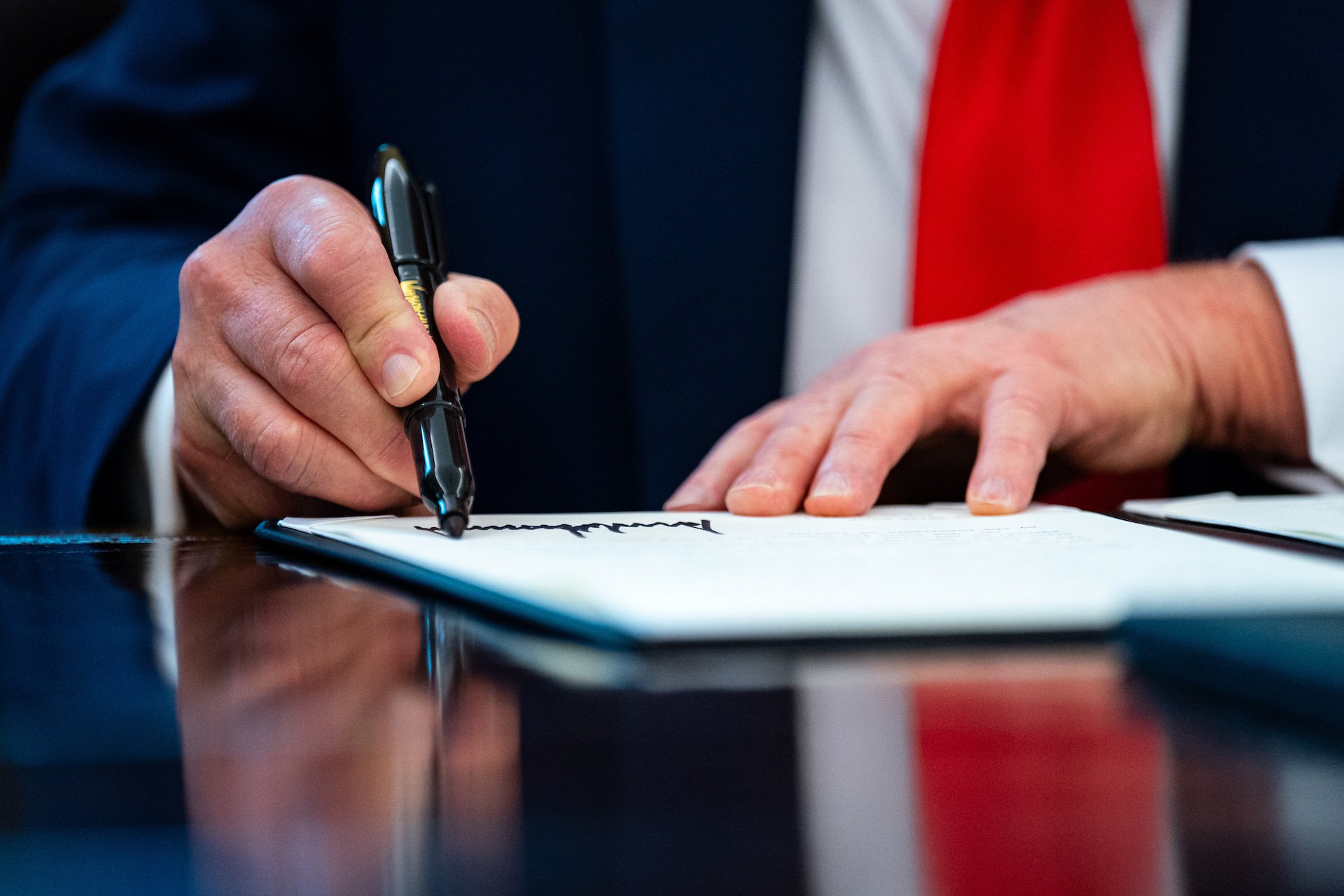
President Donald Trump announced Monday that he plans to sign an executive order permitting only “one rule” for regulating artificial intelligence in the U.S.
“There must be only One Rulebook if we are going to continue to lead in AI. We are beating ALL COUNTRIES at this point in the race, but that won’t last long if we are going to have 50 States, many of them bad actors, involved in RULES and the APPROVAL PROCESS,” Trump wrote in a Truth Social post.
Several states, including California and New York, have passed statewide legislation this year regulating various aspects of AI, including transparency, whistleblower protections, and user and teen safety. Trump did not elaborate on which states he considered bad actors in the regulatory process, or what qualified them as bad actors.
A version of an executive order that leaked online last week reportedly directed federal agency and cabinet leaders to determine how to punish states with existing AI laws, according to The Verge.
Earlier this year, Trump’s One Big Beautiful Bill Act attempted to ban state regulation of AI for 10 years, a provision that Republican Congresswoman Marjorie Taylor Green notably rejected. The moratorium was very unpopular amongst registered voters, according to a poll conducted in mid-May. The measure was eventually voted down 99-1 by the Senate. Some MAGA supporters, including Trump ally Steve Bannon, continue to oppose industry-led regulation of AI.
Still, proponents of a regulatory ban still want to provide AI companies carte blanche to innovate without having to address state-by-state regulations. David Sacks, a tech venture capitalist and the Trump administration’s special advisor for AI and crypto, is reportedly behind the executive order, according to The Verge.
It’s not clear how Trump’s executive order would affect Congressional legislation, like the bipartisan bill sponsored by Republican Sen. Josh Hawley and Democrat Sen. Mark Hawley that would require federal agencies and major U.S. companies to account for AI-related workforce reductions.
A report released last week by the tech research nonprofit Future of Life Institute found that only three of eight major AI models got a passing grade on safety.